

STUDIES
Who Owns the Cart? Agentic Shopping Assistants and the Coming Disintermediation of eCommerce Funnels
By Dr. Kevin Rudolph
21 Jul 2026
The short version
For twenty-five years, the eCommerce funnel has had one, mostly stable shape: a human searches, compares, gets nudged by merchandising and loyalty mechanics, and clicks “buy.” Every business built on that funnel - SEO agencies, affiliate networks, loyalty programs, retail media, even checkout UX teams - was really in the business of influencing a human’s attention on the way to a purchase.
That premise is now cracking, in fits and starts rather than a straight line. Through 2025, six platforms shipped real infrastructure for agents to browse, compare, and transact on a person’s behalf: OpenAI and Stripe’s Agentic Commerce Protocol, with in-chat “Instant Checkout” (OpenAI, 2025; OpenAI and Stripe, 2025); Google’s Agent Payments Protocol, backed by more than 60 payment and retail partners (Google, 2025); Visa’s Trusted Agent Protocol and Mastercard’s Agent Pay (Visa, 2025; Mastercard, 2025); PayPal’s agentic commerce toolkit (PayPal, 2025); Perplexity’s “Buy with Pro” (Perplexity, 2025); and Amazon’s agent-enabled “Rufus” (Amazon, 2025). Shopify opened its merchant catalog to third-party agents that same year (Shopify, 2026).
By early 2026, Google and Shopify had co-developed a third standard, the Universal Commerce Protocol, launched at NRF with more than 20 retailers already committed (Google, 2026). OpenAI, meanwhile, had quietly paused Instant Checkout: real adoption fell far short of its launch promise (Goldberg, 2026).
That detail matters. Our claim: disintermediation risk is not evenly spread across the funnel, and it isn’t moving at a uniform pace either. It concentrates at the top of the funnel (discovery, comparison) and the bottom (checkout, loyalty). The middle - trust, fulfillment reliability, and return handling - is becoming more valuable, not less. Checkout specifically is proving harder to disintermediate than the 2025 launches implied; see the deep dive below. That inversion is the part most commentary is missing.
Executive summary
- Search and comparison are the most exposed layer, and the data already shows it moving. Adobe Analytics measured AI-referred traffic to US retail sites up 693% year-on-year over the 2025 holiday season, converting 31% better than other traffic sources (Adobe, 2025). Twenty years of SEO, PDP (product detail page) merchandising, and comparison-shopping-engine investment built for a human reader now face an audience that reads structured data, not ranked blue links.
- Checkout is being unbundled from the merchant’s brand, but more slowly and less completely than the 2025 launches suggested. Protocol-level checkout was meant to move the trust relationship from retailer to agent platform; in practice, the highest-profile first mover struggled with adoption (see “Going deep on checkout” below), and the protocols gaining traction are the ones that route the transaction back to the merchant rather than fully replacing it.
- Loyalty programs face an identity crisis, not an extinction event. Points and tiers were built to influence a human’s choice; an agent optimizing on price and fit doesn’t respond to a loyalty nudge the way a person does, unless the loyalty value is encoded as data the agent can read and weigh.
- Fulfillment reliability, return handling, and verified reviews become the new moat. An agent that transacts on a user’s behalf is making a reputational bet on their behalf; agents will prefer merchants whose promises are machine-verifiable (accurate stock data, honored delivery windows, low dispute rates) over merchants who are merely well-marketed. Salesforce’s Cyber Week 2025 data already shows retailers with AI agent integrations growing sales 13% versus 2% for those without - a 7x gap (Salesforce, 2025).
- The near-term winner is whoever controls the “trusted agent” credential: the payment networks and platforms that decide which agents are allowed to check out on a user’s behalf at all. That’s a new, thin, powerful layer above the existing payments stack.
What actually changed, and how fast
The popular framing, “AI will replace shopping,” is too vague to act on. Here’s what actually shipped, in order, and how fast it moved - because the pace turns out to be a finding in its own right, not just color.
2024 - the pilots. Amazon’s “Rufus” shopping assistant went live inside the Amazon app, and Perplexity launched an initial “Buy with Pro” shopping feature for subscribers that November. Both were single-platform, single-vendor experiments: useful data points, but not yet infrastructure anyone else could build on.
2025 - the protocol land-grab. Three separate infrastructure layers moved in parallel, nearly all of it concentrated in the second half of the year:
- Discovery/comparison agents - chat-native assistants (in ChatGPT, Perplexity, and browser-embedded copilots) that read product pages, compare offers, and summarize a recommendation, largely still handing the human off to check out normally.
- Checkout protocols - OpenAI/Stripe’s Agentic Commerce Protocol, launched 29 September 2025 with U.S. Etsy sellers and Shopify named as flagship partners (OpenAI, 2025; Digital Commerce 360, 2025), and Google’s AP2, launched 16 September 2025 with a coalition that already included Mastercard, PayPal, American Express, and Coinbase among more than 60 named organizations (Google, 2025). Both define how an agent authenticates a purchase intent, proves it’s authorized to spend on a user’s behalf, and completes payment without a human filling out a form.
- Network-level trust rails - Visa’s Trusted Agent Protocol, launched 14 October 2025 with early input from Cloudflare, Shopify, Stripe, Microsoft, and Coinbase (Visa, 2025), and Mastercard’s Agent Pay, launched 29 April 2025 with Microsoft, IBM, and Braintree as initial partners (Mastercard, 2025). These are the card networks building a way to cryptographically distinguish “an agent I trust is buying this” from “a bot is committing fraud.” This is arguably the most consequential layer of the three: it decides which agents are even allowed to transact.
2026 - adoption reality, and a third protocol. Two things happened almost simultaneously. First, Google and Shopify co-developed a third standard, the Universal Commerce Protocol (UCP), announced by Sundar Pichai at the NRF retail conference on 11 January 2026 with a coalition of Etsy, Wayfair, Target, and Walmart already committed as design partners. It was wired into Google AI Mode, the Gemini apps, and Microsoft Copilot Checkout from the start (Google, 2026). UCP kept expanding through the spring: Cart and Catalog capabilities in March, then a cross-retailer “Universal Cart” in May with Nike, Sephora, Target, Ulta Beauty, Walmart, and Wayfair-hosted Shopify brands (Google, 2026). Mastercard extended Agent Pay internationally and, in June 2026, launched “Agent Pay for Machines” for fully autonomous, non-human-initiated transactions (Mastercard, 2026). Second, in the opposite direction, OpenAI shelved Instant Checkout in March 2026: fewer than 40 of the “over a million” promised Shopify merchants had ever gone live (Goldberg, 2026). More on this below.
Timeline: how fast this actually moved.
| Date | Milestone | Layer |
|---|---|---|
| Nov 2024 | Amazon Rufus live in-app; Perplexity launches initial “Buy with Pro” | Discovery / comparison |
| 29 Apr 2025 | Mastercard launches Agent Pay (with Microsoft, IBM, Braintree); PayPal ships agentic commerce toolkit | Checkout / trust rail |
| 16 Sep 2025 | Google launches AP2 with 60+ partner coalition | Checkout protocol |
| 29 Sep 2025 | OpenAI + Stripe launch ACP and Instant Checkout (Etsy, Shopify) | Checkout protocol |
| 14 Oct 2025 | Visa launches Trusted Agent Protocol | Trust rail |
| 18 Nov 2025 | Amazon expands Rufus: Auto-Buy, Buy for Me, cart automation | Discovery -> checkout |
| 25 Nov 2025 | Perplexity relaunches shopping as “Buy with Pro” / Instant Buy, with PayPal | Checkout |
| 5 Dec 2025 | Salesforce reports AI agents drove $67B / 20% of Cyber Week 2025 sales | Adoption evidence |
| 11 Jan 2026 | Google + Shopify launch Universal Commerce Protocol at NRF | Checkout protocol |
| 10 Mar 2026 | OpenAI pauses Instant Checkout after weak merchant adoption | Checkout (retreat) |
| 19 Mar 2026 | UCP adds Cart, Catalog, Identity Linking | Checkout protocol |
| 20 May 2026 | UCP “Universal Cart” launches with Nike, Sephora, Target, Walmart, Wayfair | Checkout protocol |
| 17 Jun 2026 | Shopify Spring ‘26: Sidekick app extensions, self-serve UCP access | Discovery + checkout |
| Jun 2026 | Mastercard launches “Agent Pay for Machines” | Trust rail |
Eight major milestones landed in the fourteen months from September 2025 to June 2026, against roughly two in all of 2024. At the level of announcements, the pace really is accelerating. At the level of proven adoption, the picture is messier: the highest-profile 2025 checkout launch is also the one that had to walk itself back within six months. The more accurate read for 2025-2026 isn’t “checkout is being disintermediated.” It’s “everyone is racing to define the rails, and the rails surviving first contact with real merchants are the ones that don’t try to cut the merchant out.”
The reason this matters for strategy, not just product, is that most of these layers are being built by infrastructure incumbents (Stripe, Visa, Mastercard, PayPal, Google, OpenAI), not by retailers. Retailers are, for now, integration partners in someone else’s protocol. That’s the same structural position that produced margin compression in prior platform shifts: hotels and OTAs, restaurants and delivery apps, publishers and social platforms. UCP’s retailer-heavy backing is the one clear counter-example so far: Etsy, Wayfair, Target, and Walmart are co-developing the protocol, not just adopting it.
The funnel, restaged
Mapping disintermediation risk stage-by-stage clarifies where to defend and where to concede.
| Funnel stage | What it does today | Disintermediation risk | Why |
|---|---|---|---|
| Discovery / search | SEO, marketplace search, paid search | Very high | Agents query structured data and APIs, not ranked blue links; classic SEO signals lose their reader |
| Comparison / research | Reviews, comparison sites, influencer content | Very high | An agent aggregates and re-summarizes comparison content itself, disintermediating the comparison layer along with the merchant |
| Merchandising / PDP | Product photography, copy, on-page persuasion | High | Persuasion designed for human emotion is largely illegible to an agent optimizing on structured attributes (price, spec, delivery date, return policy) |
| Cart / checkout | Cart UX, one-click flows, saved payment methods | High | Protocol-level checkout moves the transaction into the agent surface, bypassing the merchant’s own checkout entirely, though 2026 evidence favors merchant-hosted redirect over full in-agent completion (see deep dive below) |
| Payment / trust | Card auth, fraud screening | Medium (shifting, not shrinking) | Value doesn’t disappear; it moves to whoever issues the “trusted agent” credential (networks, wallet platforms) |
| Fulfillment / delivery | Logistics, delivery-window accuracy | Low - rising in importance | Agents can verify and weigh delivery reliability more rigorously than a human ever bothered to |
| Post-purchase / returns | Return policy, refund speed, dispute handling | Low - rising in importance | Return friction is exactly the kind of quantifiable, comparable attribute an agent is built to notice and penalize |
| Loyalty / retention | Points, tiers, membership perks | Contested | Loyalty mechanics built for human psychology need to become machine-legible value (real discounts, real priority) to survive agent-mediated purchasing |
Why the pattern holds up. The barbell shape isn’t arbitrary. It tracks which tasks agents are naturally suited to. The top of the funnel is pure information processing - reading and ranking text and structured data against a query - and Adobe’s holiday-2025 traffic data already shows the behavioral shift underway, not just the theoretical risk (Adobe, 2025). The middle of the funnel is reputation and execution: whether a stated delivery window, return policy, or stock level turns out to be true. That rewards operational discipline over persuasion, which is exactly why Baymard Institute’s long-running research on cart abandonment finds “extra costs” and “slow delivery” among the top reasons for lost sales, well before agents entered the picture (Baymard Institute, 2026). Those are pre-existing, measurable failure points, and an agent is well positioned to penalize them systematically. Checkout and loyalty, at the bottom of the funnel, are the contested infrastructure layer: the risk there is real, but per the evidence below, it’s less about the merchant being cut out and more about which incumbent ends up owning the transaction rails.
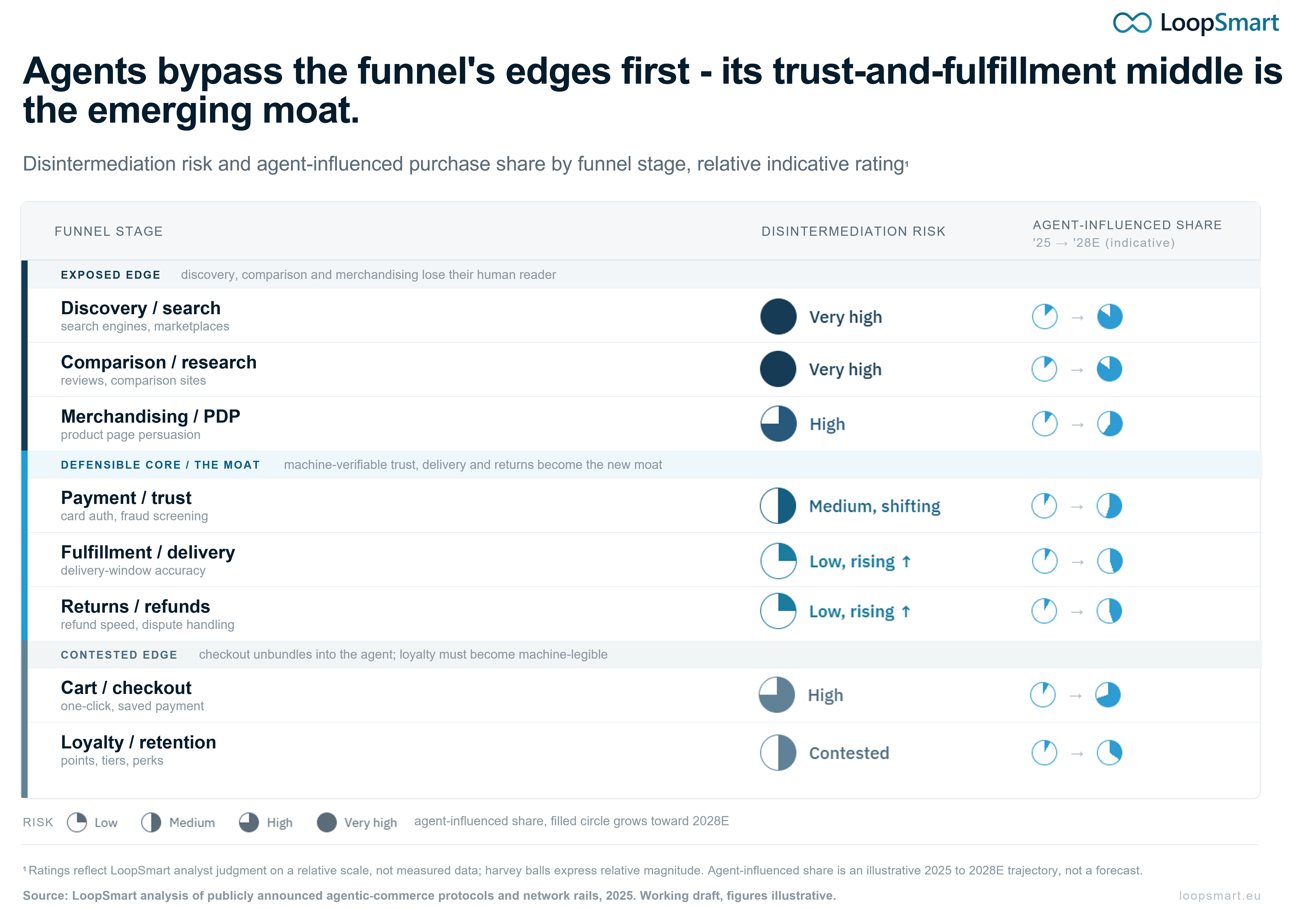
Figure 1. LoopSmart analysis of publicly announced agentic-commerce protocols and network rails. Risk ratings are analyst judgment on a relative scale, not measured data; the agent-influenced share indicator is an illustrative 2025-2028E trajectory, not a forecast.
Table 1 (illustrative projection, not measured). The estimates below sketch the same expected shape numerically, useful for modeling the trend but not for citing as fact. They are directionally consistent with the real traffic and conversion data cited above, but not derived from it. Treat every number as a placeholder pending primary research.
| Funnel stage | 2025 (baseline) | 2026E | 2027E | 2028E |
|---|---|---|---|---|
| Discovery / comparison | ~3% | ~12% | ~25% | ~40% |
| Cart / checkout (protocol-initiated) | <1% | ~5% | ~15% | ~28% |
| Loyalty-influenced repeat purchase | ~1% | ~4% | ~9% | ~15% |
Who wins, who loses
- Payment networks and checkout-protocol owners (Visa, Mastercard, Stripe, PayPal, Google, OpenAI): structurally advantaged. They are building the layer that decides which agents are allowed to spend at all - a new toll booth with no obvious competitor yet. Google’s AP2 alone launched with more than 60 named partners in September 2025, including Mastercard, PayPal, American Express, and Coinbase (Google, 2025). That’s how fast incumbents are moving to avoid being left outside the rails.
- Large marketplaces with strong first-party data (Amazon, Shopify’s merchant network): defensible in the medium term. Amazon’s Rufus reached over 250 million customers and added Auto-Buy, cart automation, and “Buy for Me” agentic purchasing in late 2025 (Amazon, 2025): a real, deployed example of a marketplace using its own data advantage instead of ceding the agent layer to a third party.
- DTC brands built on brand storytelling and emotional merchandising: exposed, and the mechanism is visible in real conversion data. Adobe found AI-referred shoppers converting 38% higher than other traffic on Black Friday 2025, extending to 42% higher by Q1 2026 (Adobe, 2026). That’s a sign structured, comparable product information is starting to out-convert narrative-driven merchandising when the “shopper” is an agent evaluating attributes, not a person absorbing a story.
- Comparison-shopping engines, coupon sites, and affiliate networks: existentially exposed - their entire business model is “be the layer a human trusts to compare for them,” which is the same layer an agent now performs natively. The 693% year-on-year growth in AI-referred retail traffic over the 2025 holiday season (Adobe, 2025) is traffic that would have flowed through exactly these intermediaries a year earlier.
- Logistics and returns-management providers: quiet winners. Baymard Institute’s ongoing cart-abandonment research already shows “extra costs too high” (40%) and “delivery too slow” (20%) among the leading reasons shoppers abandon a purchase (Baymard Institute, 2026): concrete, pre-existing evidence that fulfillment friction is a large, measurable lever agents can weigh once they’re the ones evaluating the purchase.
Going deep on checkout: what actually happened
Checkout is where the protocol activity has been fastest, and where the disintermediation stakes are highest, so it’s worth examining closely. Here’s what the public record shows, six-plus months into the 2025 launches.
OpenAI/Stripe’s Agentic Commerce Protocol: fast launch, slow adoption, early retreat. ChatGPT’s “Instant Checkout” launched 29 September 2025 with U.S. Etsy sellers live immediately and “over one million” Shopify merchants promised, including named brands like Glossier, SKIMS, Spanx, and Vuori (OpenAI, 2025; Digital Commerce 360, 2025). By March 2026, fewer than 40 of those Shopify merchants had actually gone live (Goldberg, 2026): a conversion rate from “promised” to “shipped” of well under 1%. OpenAI shelved the feature that month, citing insufficient flexibility, and pivoted back toward a discovery-plus-merchant-redirect model: ChatGPT recommends and compares, but the transaction itself happens on the retailer’s own site or app (Goldberg, 2026).
Google/Shopify’s Universal Commerce Protocol: slower start, broader coalition. UCP launched later - 11 January 2026, at NRF - but with a fundamentally different backing structure: instead of being led by an AI lab partnering with payment processors, it was co-developed by Google and Shopify with major retailers (Etsy, Wayfair, Target, Walmart) already committed as design partners, not just launch-day logos (Google, 2026). It expanded twice in the following months: Cart and Catalog capabilities added in March, a cross-retailer “Universal Cart” spanning Google Search, Gemini, YouTube, and Gmail launched in May, with Nike, Sephora, Target, Ulta Beauty, Walmart, and Wayfair-hosted Shopify brands as partners (Google, 2026).
The pattern. The protocol that tried to route the transaction into the AI platform’s own surface struggled with real merchant adoption and had to retreat within six months. The protocol built with retailers, designed to keep the transaction on merchant-controlled surfaces while standardizing how agents discover and initiate it, kept expanding. This isn’t proof UCP wins long-term: it only launched in January 2026, and Mastercard, Visa, and PayPal are all still building competing or complementary rails of their own (Mastercard, 2026; Visa, 2025; PayPal, 2025). But it’s a real, testable early signal, and it argues for revising the “Cart / checkout” rating in the table above. Read it less as “high risk of losing the transaction” and more as “high risk of losing the standalone checkout experience as a differentiator” - at least for merchants who integrate with a retailer-backed protocol rather than betting on an AI platform’s own in-chat commerce layer.
Three bold calls
- The cart is dying; intent is what’s left, just not necessarily inside the chat window. OpenAI’s Instant Checkout retreat is a data point about where the cart dies, not whether it does. Within a few years, “add to cart” will look as dated as “add to Winamp playlist,” regardless of which surface completes the transaction. The unit of commerce becomes a standing, revocable purchase intent an agent holds on a user’s behalf, not a session-bound cart a human fills and abandons.
- Loyalty programs as currently designed won’t survive agentic purchasing. Loyalty as a pricing signal will. Points and badges are a human psychology hack; an agent doesn’t feel special. But a loyalty program that translates into a genuine, machine-readable price or priority advantage will get more powerful, because it’s now a decision input instead of a marketing message.
- The next retail-media war will be fought over API access, not ad inventory. Retail media (Amazon Ads, Walmart Connect, and peers) built a multi-billion-dollar business selling attention on a page a human reads. When the reader is an agent, the sellable asset shifts to preferred placement in the agent’s structured comparison - a fundamentally different, and currently unpriced, product.
The bottom line
If you sell through any of these surfaces, the near-term move isn’t picking a single winning protocol; that race isn’t decided yet. It’s making sure product data, delivery promises, and return policies are accurate and machine-readable, since that’s the layer agents are already learning to trust or distrust. Protocols will keep shifting. Fulfillment discipline won’t go out of style.
Sources and further reading
Full references for every source cited above, in Harvard style. Checked directly where possible, or via the closest available secondary reporting, as of 22 July 2026.
Adobe (2025) Generative AI-powered shopping rises with traffic to retail sites, Adobe Business Blog. Available at: https://business.adobe.com/blog/generative-ai-powered-shopping-rises-with-traffic-to-retail-sites (Accessed: 22 July 2026).
Adobe (2026) AI traffic surges across industries, retail sees biggest gains, Adobe Business Blog. Available at: https://business.adobe.com/blog/ai-driven-traffic-surges-across-industries (Accessed: 22 July 2026).
Amazon (2025) Amazon Rufus AI assistant: new personalized shopping features, About Amazon, 18 November. Available at: https://www.aboutamazon.com/news/retail/amazon-rufus-ai-assistant-personalized-shopping-features (Accessed: 22 July 2026).
Baymard Institute (2026) 50 Cart Abandonment Rate Statistics, Baymard Institute. Available at: https://baymard.com/lists/cart-abandonment-rate (Accessed: 22 July 2026).
Digital Commerce 360 (2025) ChatGPT debuts new checkout experience with Etsy, Shopify merchants as early users, 30 September. Available at: https://www.digitalcommerce360.com/2025/09/30/chatgpt-debuts-checkout-experience-etsy-shopify-merchants/ (Accessed: 22 July 2026).
Goldberg, J. (2026) ‘Why OpenAI’s checkout retreat spells trouble for its commerce strategy’, Forbes, 10 March. Available at: https://www.forbes.com/sites/jasongoldberg/2026/03/10/why-openais-checkout-retreat-spells-trouble-for-its-commerce-strategy/ (Accessed: 22 July 2026).
Google (2025) Announcing Agents to Payments (AP2) Protocol, Google Cloud Blog, 16 September. Available at: https://cloud.google.com/blog/products/ai-machine-learning/announcing-agents-to-payments-ap2-protocol (Accessed: 22 July 2026).
Google (2026) Read Sundar Pichai’s remarks at the 2026 National Retail Federation, Google Blog, 11 January. Available at: https://blog.google/company-news/inside-google/message-ceo/nrf-2026-remarks/ (Accessed: 22 July 2026).
Mastercard (2025) Mastercard unveils Agent Pay, pioneering agentic payments technology to power commerce in the age of AI, Mastercard Newsroom, 29 April. Available at: https://www.mastercard.com/global/en/news-and-trends/press/2025/april/mastercard-unveils-agent-pay-pioneering-agentic-payments-technology-to-power-commerce-in-the-age-of-ai.html (Accessed: 22 July 2026).
Mastercard (2026) Mastercard launches Agent Pay for Machines to unlock super-fast, always-on payments, Mastercard Newsroom, June. Available at: https://www.mastercard.com/us/en/news-and-trends/press/2026/june/mastercard-launches-agent-pay-for-machines.html (Accessed: 22 July 2026).
OpenAI (2025) Buy it in ChatGPT, OpenAI, 29 September. Available at: https://openai.com/de-DE/index/buy-it-in-chatgpt/ (Accessed: 22 July 2026).
OpenAI and Stripe (2025) Agentic Commerce Protocol. Available at: https://www.agenticcommerce.dev/ (Accessed: 22 July 2026).
PayPal (2025) PayPal brings together developers, AI leaders to power agentic commerce at Dev Days, PayPal Newsroom, 29 April. Available at: https://newsroom.paypal-corp.com/2025-04-29-PayPal-Brings-Together-Developers,-AI-Leaders-to-Power-Agentic-Commerce-at-Dev-Days (Accessed: 22 July 2026).
Perplexity (2025) Shopping that puts you first, Perplexity Blog, 25 November. Available at: https://www.perplexity.ai/hub/blog/shopping-that-puts-you-first (Accessed: 22 July 2026).
Salesforce (2025) Salesforce data: AI and agents propel Cyber Week to record $336.6B in global spend, Salesforce Newsroom, 5 December. Available at: https://www.salesforce.com/news/press-releases/2025/12/05/cyber-week-ai-agents-sales/ (Accessed: 22 July 2026).
Shopify (2026) Spring ‘26 Edition: what’s new for developers, Shopify News, 17 June. Available at: https://www.shopify.com/news/spring-26-edition-dev (Accessed: 22 July 2026).
Visa (2025) Visa Introduces Trusted Agent Protocol: An Ecosystem-Led Framework for AI Commerce, Visa Investor News, 14 October. Available at: https://investor.visa.com/news/news-details/2025/Visa-Introduces-Trusted-Agent-Protocol-An-Ecosystem-Led-Framework-for-AI-Commerce/default.aspx (Accessed: 22 July 2026).
Visa (n.d.) Visa Intelligent Commerce, Visa Developer Center. Available at: https://developer.visa.com/capabilities/visa-intelligent-commerce (Accessed: 22 July 2026).
ABOUT THE AUTHOR(S)
Dr. Kevin Rudolph is a Managing Director in LoopSmart's Pegeia office (Cyprus).